





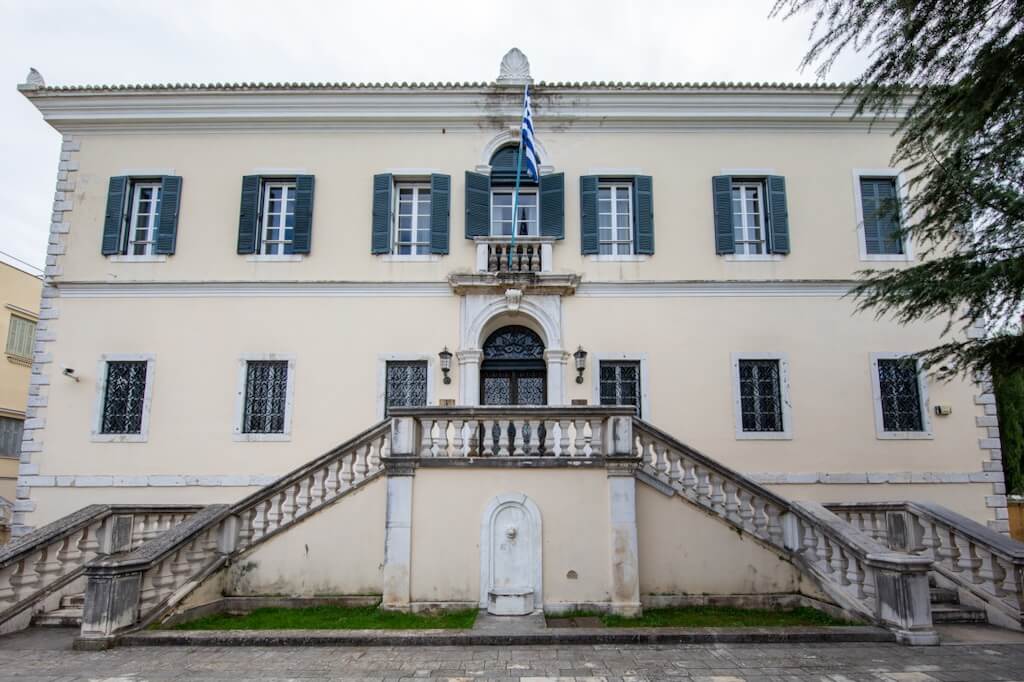
The majestic and imposing building located in the Town Hall Square was built in 1630 and was the residence of the Latin Archbishop of Corfu. The original building was destroyed due to two successive earthquakes in 1743 and 1745 and was rebuilt by Archbishop Nani in 1754 in a more magnificent form. During the period of the French Revolution (1798-1799), the building was used for the meetings of the Provisional Town Hall. Then, during the period of the Ionian State (Septinsular Republic), the residence was used as the seat of the Ionian Senate until 1824 when its seat was moved to the then newly built Palace of St. Michael and St. George. After the Union of the Ionian Islands with Greece, it operated as a court until 1943, when it suffered serious damage due to the bombings of World War II. After its reconstruction, it became the property of the Bank of Greece which until recently housed its branch in Corfu. The exterior form of the building is simple. Its windows and balconies are typical examples of the Venetian architecture. A double staircase with marble balustrades, the so-called balustrade, leads to the arched entrance with a stone window. Above the entrance and in a central position there is the balcony decorated with Doric columns. The central door of the floor is also arched. Before the war there was another floor that occupied only the central part. The architrave was supported on four pillars and was crowned by a pediment with a relief of the lion of Venice. At the back of the building there is a garden, which is enclosed to the south by the ruins of the women's prisons of Corfu during the Venetian period.
References: Αγοροπούλου-Μπιρμπίλη, Α.: Η αρχιτεκτονική της πόλεως της Κέρκυρας κατά την περίοδο της Ενετοκρατίας, Εθνικό Μετσόβιο Πολυτεχνείο, Αθήνα 1976, σελ. 244-248. Ψηφιακό Αρχείο Ι. Καποδίστρια: http://kapodistrias.digitalarchive.gr/walk_corfu.php?id=4
Address: 1, Dimarchou Kolla Str., GR-49131 Corfu, Greece